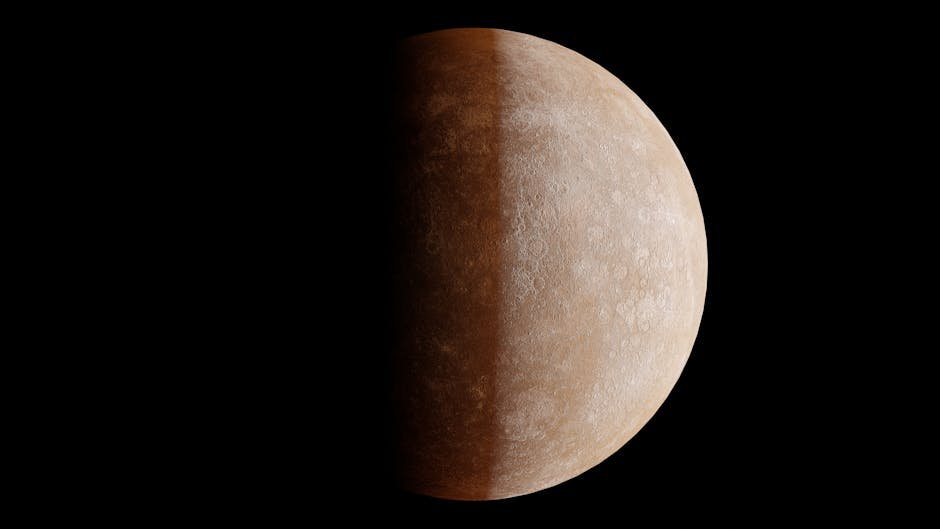
Mercury Diamonds: Our Star’s Sparkling Secret
Forget Mars. Or Venus. Ever think about Mercury? Nah, probably not. Just that little burnt-out rock right by the sun, right? Wrong. Listen up. This seemingly dead orb? It’s swimming in treasure. We’re talking Mercury Diamonds. Quadrillions of tons, maybe. Stuck right under its cooking-hot surface. It’s a game-changer for our forgotten rocky buddy. And yeah, billionaires are all over this for the next big score.
Mercury’s Crazy Heat Swings
Get this: temperatures there can literally zap you. Instantly. During its day, the equator? Cooked. A brutal 430°C (800°F). But then the night hits. Boom: -180°C (-290°F). A wild 610°C swing!
Why the crazy extremes? Simple. No real air cover. Just this super thin, floaty ‘exosphere’ stuff – bits of oxygen, sodium, hydrogen, helium, potassium. Really, it’s a vacuum. Zero protection from the sun’s harsh rays. Or space’s deep freeze. And because a Mercury day takes 59 Earth days, some spots see multiple sunrises and sunsets. Not a vacation spot, though. For real.
Small Planet, HUGE Metal Heart
Okay, so this tiny planet. One-third Earth’s size, smaller than some moons even. Only 5% of our mass. But it’s heavy! Seriously. Its iron core? Unbelievably, it’s 85% of the total. When Mariner 10 poked around in the ’70s, scientists just scratched their heads.
What we call “Mercury”? Just a thin, rocky skin over this enormous metal lump. Some smart folks think huge impacts, like four billion years ago, ripped away most of its original outer bits. Left just this massive core. It’s like a big metal ball with a paper-thin rock coat.
Mercury’s Weird Magnetic Shield
Even though it’s practically sitting on the sun’s lap, bathed in killer radiation, and tiny, Mercury has a weak magnetic field. But it’s stable. Weird, right? A real mystery. Our planet’s magnetic field keeps us safe, mostly. And Mercury’s? Only 1% of ours. Still, it works.
And this field? It tells us something cool: it’s got a liquid, molten core. Yeah, Mercury spins super slow. 59 Earth days for one turn! But that slow grind? Enough to make its own magnetism. Keeps the field going. Pretty impressive, stuck that close to a star.
Missions Confirm Hidden Diamond Troves
First, we sent Mariner 10 in ’73. Just a peek. Then Messenger, 2011. And another thing: ESA’s BepiColombo, launched 2018, finally gets to orbit Mercury in 2025. Yeah, a loooong trip. Years from launch to arrival. Why? Because probes can’t just blast straight there. They do cosmic slingshots using other planets! Saves tons of fuel. And money.
These missions? They’re coughing up some wild info. We knew the surface had carbon and graphite. But recent finds? Planet science is freaking out. A 2022 calculation? Insane. Mercury could have 16 quadrillion tons of pure diamond. I know, sounds like a made-up number. We’re still hashing out precise amounts. But Messenger and BepiColombo both confirm a thick diamond layer. We’re talking colossal. 16 kilometers (10 miles) down. Right under that fried crust. A huge diamond field just waiting.
The Push for Space Mining: Cash and Beyond
That diamond find? Everything changed. That “boring” planet? Poof. Hottest thing going for big companies and rich space folks. And they’re not just after jewelry diamonds. These stones? Super useful for industrial stuff. Tech. Drills. Cutting tools.
And another thing: Beyond diamonds, there’s probably more valuable iron and carbon compounds. A giant treasure chest! People used to laugh at mining a whole planet. But when there’s billions on the line, and everyone wants rare stuff? Anything goes. No life on Mercury. No settling there. But its money-making power? Through the roof.
Questions People Ask About Mercury
So, how hot and cold does it get?
Daytime equator? Gets to a roasting 430°C (800°F). Nighttime? Drops to a freezing -180°C (-290°F). Crazy, huh?
How long is a day? And a year?
One Mercury day (that’s one spin) takes about 59 Earth days. But its year (around the sun)? Way faster. Just 88 Earth days.
Why does it take so long for probes to get there?
They do these “gravity assists.” Like a slingshot around other planets. Helps them pick up speed and steer without burning tons of costly fuel. Longer trip? Yeah. But hugely cheaper and smarter than flying straight.