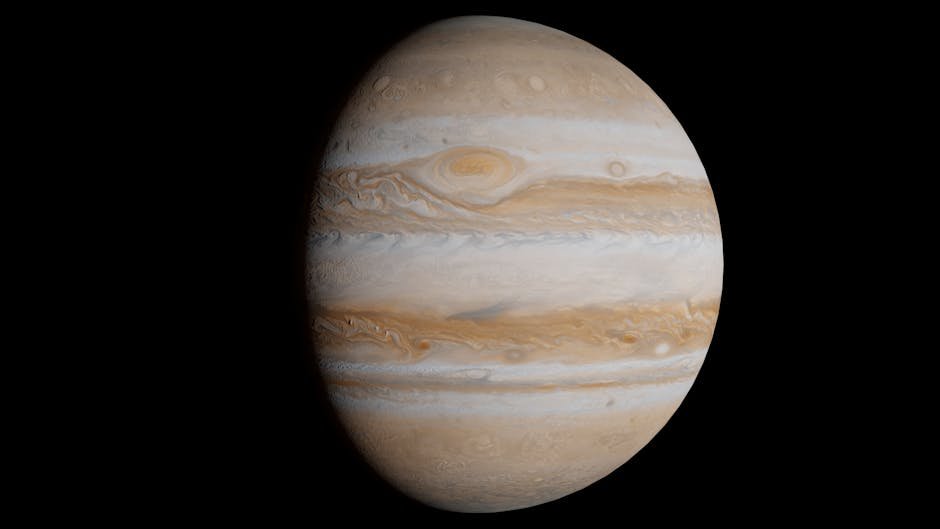
Think our Sun calls all the shots? Nah. Think again. The sheer gravity of Jupiter? It’s intense, truly intense. So strong, it actually pulls on the Sun, making our star wobble in a 12-year jig around a shared center. A real powerhouse. If it had been just 30% chonkier, this cosmic giant would’ve cranked up to be its own low-budget star, a brown dwarf. This gas giant runs the show in our solar system. An absolute boss.
Diving Into Jupiter: What’s the Deal?
Jupiter: Not Your Average Gas Giant
Jupiter isn’t just big; it’s a massive blob of hydrogen and helium, basically a star that didn’t quite make it. But a huge one. There’s no solid spot to land. Just endless, swirling gas. Kind of a wild, chaotic vibe. This titan formed way out past the “snow line” ages ago in our solar system. That’s a spot where ice and lighter gases like hydrogen and helium could really chill out and glob together. And glob they did. The outcome? A world 10 times wider than Earth. Also, 300 times more massive. Wow.
The System’s Speed Demon
This planet isn’t just massive; it’s fast. Jupiter whips around on its axis quicker than any other planet. Just 9 hours and 56 minutes for a full spin. This crazy speed gives it a bit of a beer belly. Seriously! Jupiter’s noticeably fatter at its middle than at its poles. A real chunky equator, we’re talking a 4,600-kilometer difference in radius. Spin that much? You’d pooch out, too.
The Great Red Spot: A Storm for the History Books
You literally can’t even mention Jupiter without hitting on its most famous face mark: the Great Red Spot. This isn’t just a tiny splotch. Oh no. It’s a massive, squiggly storm. At its widest, it spans 40,000 kilometers across, big enough to totally swallow Earth. And it’s been going on for ages. First seen way back in 1665 by Giovanni Cassini, this cyclone has been tearing across Jupiter’s top layer for at least 350 years. Maybe even longer. It just keeps on pushing through.
A Powerhouse Magnet and Light Shows
Jupiter’s got a magnetic field that makes Earth’s look, well, puny. It’s a staggering 14 times stronger than ours. This super strong magnetic field cranks out some seriously epic auroras. Way more spectacular than our humble Northern Lights. These charged bits, from the Sun or even Jupiter itself, crash into the magnetic field. What happens? A light show! It can cover areas as huge as Earth. A nonstop cosmic fireworks display. Just amazing.
The Enigma of Metallic Hydrogen
Deep inside Jupiter, things get straight-up wild. Folks figure that about 20,000 kilometers down from its cloudy outer layer, the planet’s core holds something crazy: metallic hydrogen. This isn’t hydrogen you find every day. It’s a strange material. A type of hydrogen gas forced by immense pressure into a crystal shape that acts like a metal, like, conducting electricity just like copper or iron. It’s been thought about since 1935 but is still almost impossible to make in our labs here on Earth. Just shows the insane conditions out there.
Keeping the Asteroid Belt in Check
Jupiter isn’t just a pretty face. No way. It’s basically the solar system’s main security guard. Its massive gravitational tug acts like a cosmic shepherd. Straightening out the asteroid belt. There are almost 2 million asteroids bigger than a kilometer out there, left over from when our solar system first started. Without Jupiter’s firm hand, who knows what kind of cosmic mess would be smashing into the inner planets. Including ours. Yes, it’s maintaining the peace.
Jupiter’s Moons: Whole Worlds on Their Own
And you can’t forget Jupiter’s moon gang! The famous ones are the four Galilean moons: Io, Europa, Ganymede, and Callisto. Each one is a unique hangout. With its own story. Io, a volcanic heck hole. Europa, perhaps hiding an ocean with life underneath its ice. Ganymede, the biggest moon in the whole solar system, even bigger than Mercury! And Callisto, a super old, cratered globe. These moons, doing their own dances around Jupiter, drop hints about life and crazy new places right here in our cosmic stomping ground.
This gas giant? It’s a true wonder. A testament to how powerful and mysterious our universe is. What other secrets is it holding deep in all those swirling clouds? We’re for sure just scratching the surface.
FAQs (People Ask This Stuff)
Q: What’s Jupiter mostly made of?
A: Jupiter is mostly made of hydrogen and helium, like a star. It’s got no solid ground.
Q: How old is the Great Red Spot?
A: It’s been seen for at least 350 years. Maybe even older, folks say.
Q: Are there Jupiter moons that might have life?
A: Yeah, some. Europa, for one, is thought to have an underground ocean that totally could support life.